I have spent the last 15 years in the trenches of SEO, content strategy, and digital automation. I’ve seen the rise of dropshipping, the peak of SMMA (Social Media Marketing Agencies), and the crypto boom. But I can tell you with absolute certainty: nothing has shifted the landscape quite like the AI Automation Agency model.
If you are reading this, you are likely tired of just “playing around” with ChatGPT. You want to know how to monetize this wave. You are looking for a roadmap to transition from an enthusiast to a business owner. The market is shifting aggressively from “learning AI” to “buying AI solutions,” and right now, there is a massive shortage of people who can actually deliver those solutions.
In this guide, I’m going to walk you through exactly how to start an AI automation agency, from the tech stack to landing your first high-ticket client. This isn’t theory; this is the exact framework I use to optimize workflows for enterprise clients.
Why the AI Automation Agency Business Model is Winning Right Now
Let’s address the elephant in the room. Why start an AI Automation Agency now? The answer lies in the “Implementation Gap.”

Business owners know AI is powerful. They read about it in Forbes. They see it on LinkedIn. But they have absolutely no idea how to connect OpenAI’s API to their CRM database without breaking everything. That is where you come in. unlike traditional software development agencies that charge $50,000 for custom code, an AAA leverages no-code automation tools to build solutions faster and cheaper, while maintaining high profit margins.
I have seen businesses pay upwards of $5,000 for a setup that took me three hours to build using tools like Make (formerly Integromat) and Stack AI. The value isn’t in the time you spend; it’s in the efficiency you provide.
According to a report by McKinsey & Company, generative AI could add trillions of dollars in value to the global economy. By positioning yourself now, you are securing a slice of that pie.
Phase 1: The “No-Code” Tech Stack Preparation
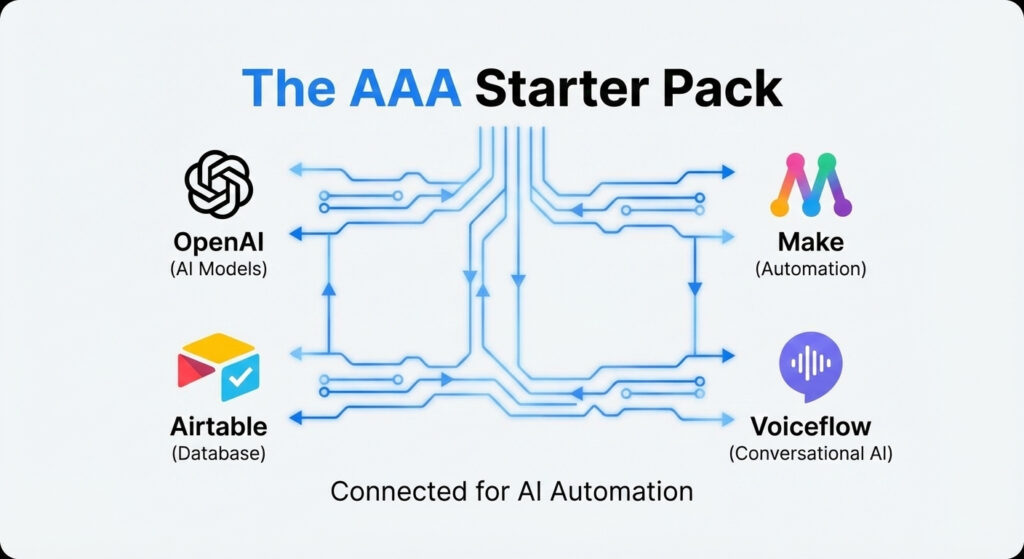
Before you sell a single service, you need your toolkit. As an expert who has debugged thousands of workflows, I advise you to keep it simple initially. You do not need to be a Python developer, but you do need to master logic.
Here is what I personally use and recommend:
- The Brain: OpenAI API (GPT-4o or GPT-4-Turbo). Do not just use the ChatGPT web interface; you need the API keys to integrate into other apps.
- The Glue (Automation): Make.com or Zapier. I prefer Make for complex logic branches, but Zapier is easier for beginners.
- The Database: Airtable. It acts as the memory for your AI agents.
- The Front-end: Softr or Voiceflow. This is what your client actually sees and interacts with.
Pro Tip: Always set usage limits on your OpenAI API billing settings immediately. I once left a loop running overnight on a test project and woke up to a $400 bill because I didn’t set a hard cap. Don’t make my mistake.
Phase 2: Step-by-Step AI Automation Agency Roadmap
Many gurus will tell you to “just find a niche.” That is too vague. Here is a granular, step-by-step process to launching.
Step 1: Define High-Value AI Agency Services
You cannot simply say “I do AI.” You need specific offers. Through my analysis of current market demands, these are the three most profitable AI services you can offer right now:
- Customer Support Chatbots: Not the dumb buttons that say “Please email us.” I’m talking about Chatbots trained on the company’s specific data (Knowledge Base) that can answer complex queries instantly.
- Outreach Automation: Systems that scrape leads, qualify them using AI analysis, and generate personalized cold emails.
- Content Generation Workflows: turning a single YouTube video into a blog post, 5 tweets, a LinkedIn article, and a newsletter automatically.
When you pitch this, focus on the ROI. “I will save you 20 hours a week” sells better than “I will build you a bot.”
Step 2: Niche Down (The “Blue Ocean” Strategy)
Don’t target “businesses.” Target “Real Estate Agents in Florida” or “Dental Clinics in London.” The more specific your niche, the easier it is to replicate your results. If you build a great lead qualification system for one dentist, you can copy-paste that system for 50 other dentists with minimal changes. This is the secret to scaling an AI Automation Agency efficiently.
Step 3: Building Your MVP (Minimum Viable Product)
Let’s build a simple internal tool to prove you can do it. We will build a “Review Responder” that automatically drafts replies to Google Reviews.
The Workflow:
1. Trigger: A new review comes in (via Google My Business API or Zapier).
2. Action: Send the review text to OpenAI API with a prompt: “You are a polite customer service manager. Write a response to this review: [Review Text].”
3. Output: Update a Google Sheet or draft the reply in the GMB dashboard.

Once you build this, you have a portfolio piece. You are no longer talking about theory; you are showing a working product.
Step 4: Client Acquisition & Outreach
This is where most fail. Do not rely on Upwork. To start an AI agency properly, you need to do cold outreach or content marketing.
I recommend the “Free Value” approach. Find a prospect who has a broken process (e.g., a slow support chat) and send them a Loom video showing a demo of how your AI bot handles their specific questions instantly. Visual proof is undeniable.
Common Troubleshooting & The “Expert’s Reality”
As much as I love this industry, it is not all sunshine and rainbows. Here are the technical hurdles you will face, and how I fix them.
1. The Hallucination Problem
The Issue: Your AI chatbot tells a customer that the product costs $10 when it actually costs $100.
The Fix: You must lower the “Temperature” parameter in your API settings to 0. This makes the AI more deterministic and less creative. Furthermore, use RAG (Retrieval-Augmented Generation) where the AI is forced to reference a specific uploaded PDF or text file before answering. Never let the AI “guess.”
2. Token Limits and Context Windows
The Issue: You try to feed a 500-page book into GPT-4 and it crashes.
The Fix: Understand “Context Windows.” If a document is too large, you need to “chunk” the data (break it into small pieces), store it in a vector database (like Pinecone), and only retrieve the relevant chunks when a question is asked. This is a core skill for any serious AI Automation Agency.
3. API Timeouts

The Issue: Make or Zapier stops waiting for OpenAI because the generation took too long.
The Fix: Increase the timeout settings in your HTTP requests, or switch to an asynchronous workflow where the AI sends a “Webhook” back to your system when it’s finished, rather than keeping the connection open.
Expert Pro Tips for Long-Term Success
“Don’t sell the plane, sell the destination.”
Tip #1: The Retainer Model. Do not just charge a one-time setup fee. AI requires maintenance. Prompts need tweaking, data needs updating. Charge a monthly retainer (e.g., $1,000/month) to maintain and improve the automation. This builds recurring revenue, which increases the valuation of your AI Automation Agency.
Tip #2: Data Privacy is Paramount. If you are working with healthcare or legal clients, you cannot just paste their data into public ChatGPT. You must use OpenAI Enterprise or open-source local models (like Llama 3) to ensure data privacy. Ignoring this can get you sued.
Tip #3: Master Prompt Engineering. The difference between a mediocre output and a stellar one is often the “System Prompt.” Spend time learning how to structure instructions using the CO-STAR framework (Context, Objective, Style, Tone, Audience, Response).
Conclusion: The Time to Act is Now
The window of opportunity to establish yourself as a dominant AI Automation Agency is wide open, but it is closing. We are in the “Wild West” phase where speed of implementation beats perfection.
You have the roadmap. You know the tech stack. You know the services to offer. The only variable left is your willingness to execute. Start by building one simple automation today. Not tomorrow—today.
If you are ready to transform your career and build a future-proof business, stop consuming content and start building. The world doesn’t need more AI students; it needs AI architects.
Frequently Asked Questions (FAQ)
How much does it cost to start an AI Automation Agency?
You can start with very low capital. The essential tools (Make, OpenAI API, Softr) often have free tiers or low-cost starter plans. You can realistically launch with under $100/month in software costs.
Do I need to know how to code?
No. The entire premise of the modern AI Automation Agency is built on “No-code” or “Low-code” platforms. However, understanding basic logic (if/then statements) and how APIs talk to each other is crucial.
What is the most profitable niche for an AI agency?
B2B niches with high customer values (High LTV) are best. Real Estate, Legal Services, Private Healthcare, and Financial Services are highly profitable because saving them just one lead is worth thousands of dollars.
Is the AI agency market saturated?
While interest is high, the market for competent execution is not saturated. Most people are just selling generic prompts. Agencies that build robust, integrated workflows are in extremely high demand.